Aeronautical Decision Making
The Most Important Non-Technical Topic
Aeronautical Decision Making (ADM) may seem like soft skills, but the FAA tests it extensively. The principle is straightforward: most accidents happen not because of equipment failure, but because of poor decisions.
The IMSAFE Checklist
Before every flight, evaluate yourself using IMSAFE:
| Letter | Factor | Question |
|---|---|---|
| I | Illness | Am I sick? Even a cold affects performance. |
| M | Medication | Am I taking anything that could impair me? |
| S | Stress | Am I under unusual pressure? (work, personal, deadline) |
| A | Alcohol | Have I consumed alcohol in the last 8 hours? |
| F | Fatigue | Am I well-rested? Tired pilots make mistakes. |
| E | Emotion | Am I in a good mental state? (angry, distracted, rushed) |
IMSAFE is tested directly. The FAA will present a scenario and ask which IMSAFE factor applies. “Pilot had a fight with spouse, then went flying” equals Emotion. “Pilot took cold medication” equals Medication.
The PAVE Checklist
Evaluate the risk factors before flight:
| Letter | Factor | What to Check |
|---|---|---|
| P | Pilot | IMSAFE, currency, experience level |
| A | Aircraft | Is it airworthy? Properly maintained? Within weight limits? |
| e | Environment | Weather, airspace, obstacles, terrain, time of day |
| V | External pressures | Client deadlines, financial pressure, “get-home-itis” |
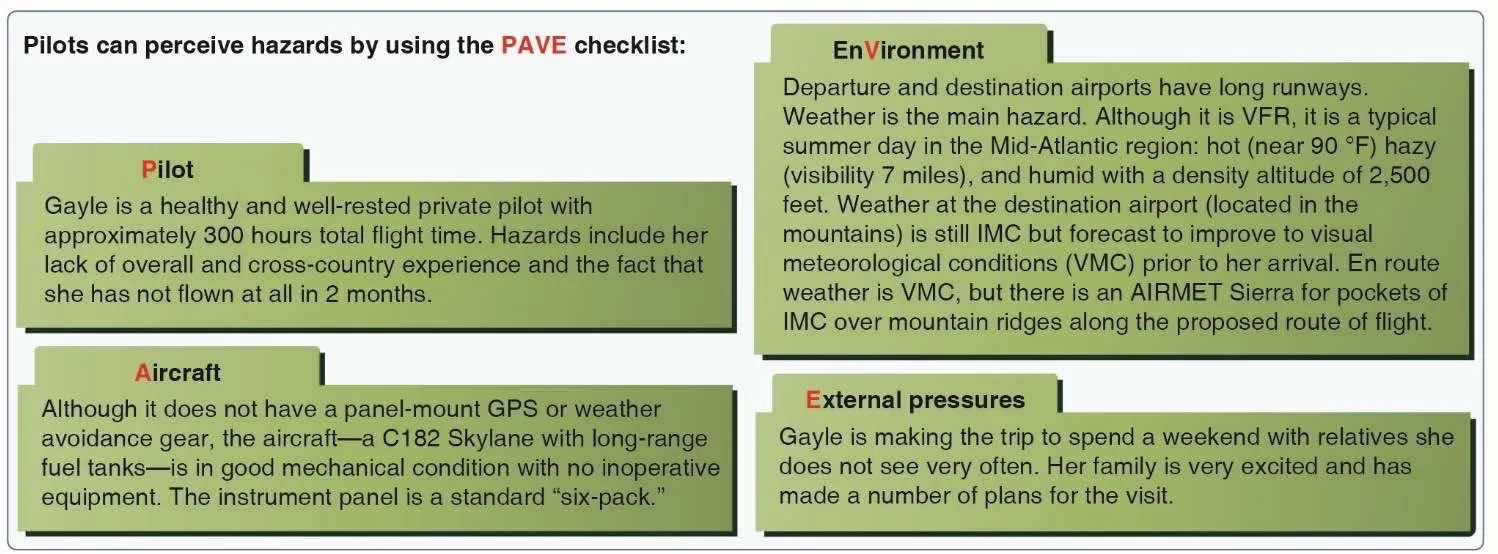
External pressures are the most dangerous risk factor. The pressure to “just get it done” leads to bad decisions. Always be willing to cancel or postpone.
The Five Hazardous Attitudes
The FAA identifies five attitudes that lead to poor decisions:
1. Anti-Authority (“Don’t tell me”)
- Resentment of rules and procedures
- Antidote: “Follow the rules. They’re usually right.”
2. Impulsivity (“Do it quickly”)
- Acting on the first idea without considering alternatives
- Antidote: “Not so fast. Think first.”
3. Invulnerability (“It won’t happen to me”)
- Believing accidents happen to other people
- Antidote: “It could happen to me.”
4. Macho (“I can do it”)
- Trying to prove yourself by taking risks
- Antidote: “Taking chances is foolish.”
5. Resignation (“What’s the use?”)
- Feeling that your actions don’t matter
- Antidote: “I’m not helpless. I can make a difference.”
The FAA gives you a scenario, identifies the hazardous attitude, and asks for the antidote. Memorize the five attitudes and their antidotes.
Crew Resource Management (CRM)
CRM applies even to small drone crews:
- Communication: clear, closed-loop communication (repeat back instructions)
- Situational awareness: everyone knows what’s happening at all times
- Workload management: distribute tasks to avoid overloading the PIC
- Assertiveness: a VO should feel comfortable saying “I lost sight of the drone!”
The FAA tests that crewmembers should speak up about safety concerns, regardless of hierarchy. A visual observer who loses sight of the drone MUST tell the PIC immediately.
Risk Management Process
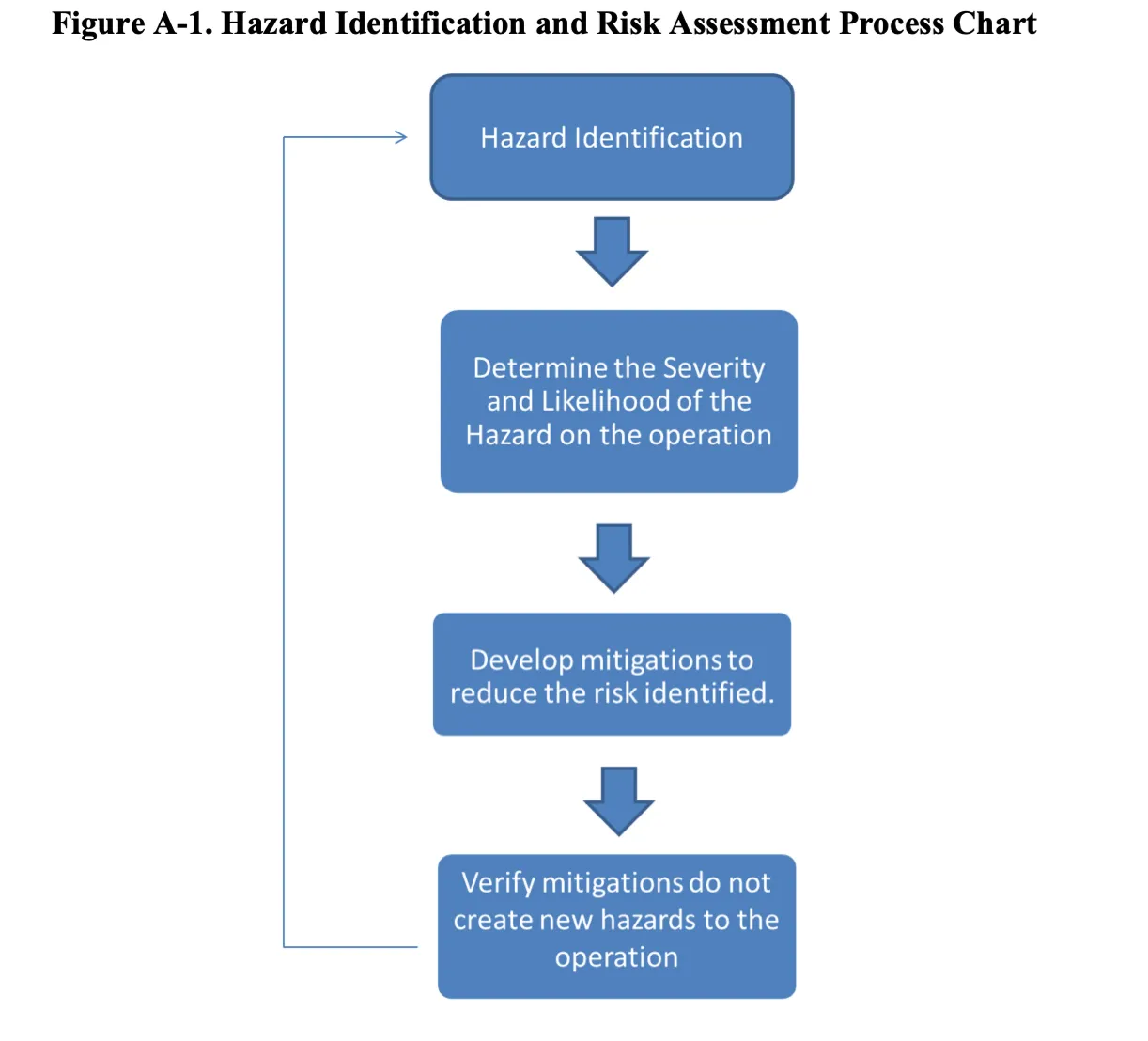
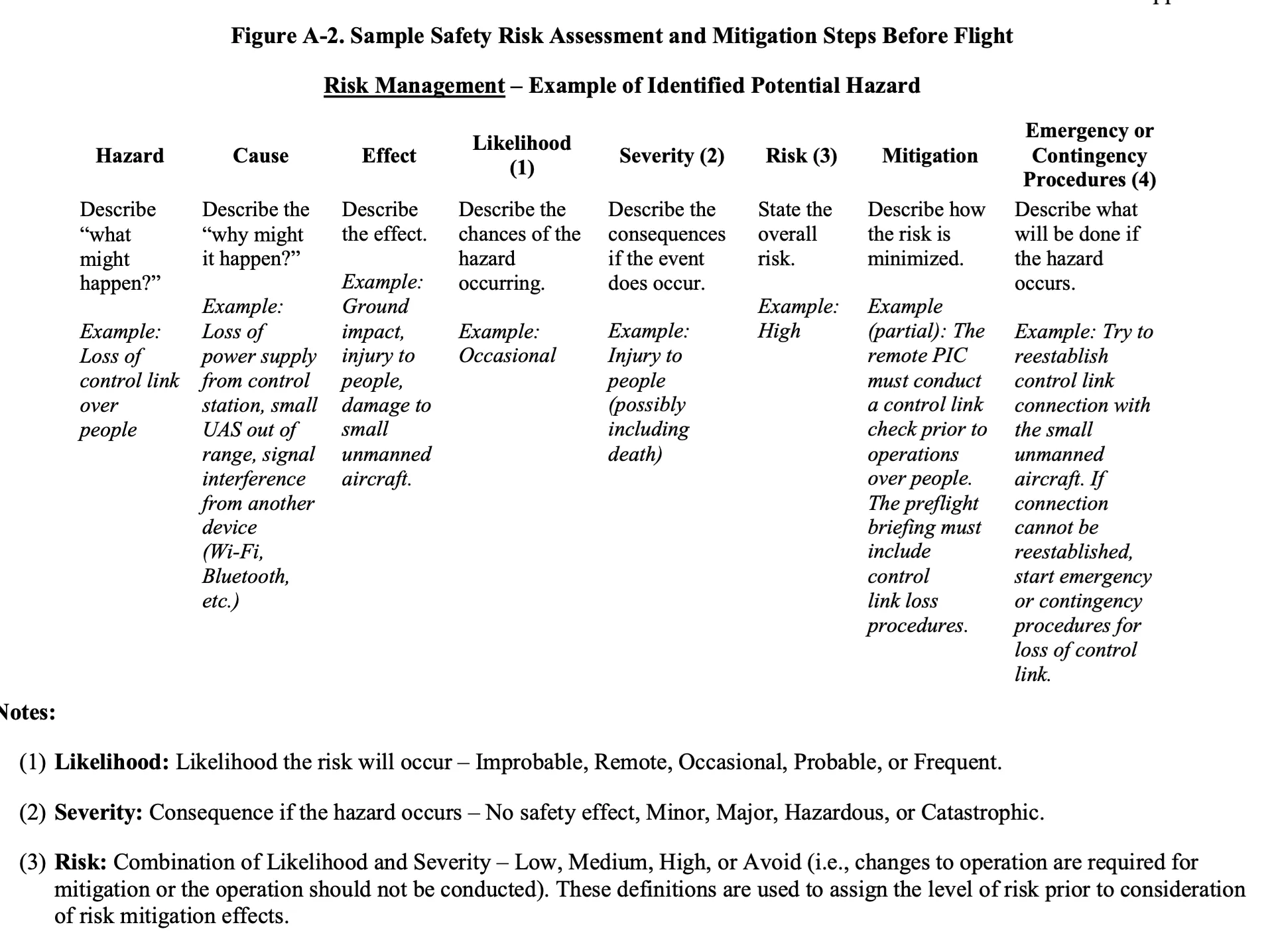
- Identify hazards: what could go wrong?
- Assess risk: how likely and how severe?
- Mitigate risk: what can you do to reduce it?
- Make decision: accept, reduce, or eliminate the risk
Deciding to Fly or Not
Use the “3P model” (Perceive, Process, Perform):
- Perceive the hazards
- Process their impact on safety
- Perform the best course of action
The DECIDE Model
For decisions that unfold in real time, the FAA’s model spells the process literally:
- D — Detect the change (weather shifting, aircraft misbehaving, a helicopter inbound)
- E — Estimate the significance: does this actually threaten the operation?
- C — Choose an outcome — what do you need to happen next?
- I — Identify actions that could produce that outcome
- D — Do the best one
- E — Evaluate the effect of the action, and be ready to run the loop again
DECIDE and the 3P model are cousins: both force the pause between noticing and acting, which is exactly where the hazardous attitudes try to live.
A Numeric Risk Matrix
Making risk arithmetic forces honest comparisons. Score each hazard likelihood 1–3 (remote / possible / probable) and severity 1–3 (minor injury or minor damage / serious injury or major damage / fatal or aircraft destroyed), multiply, and read the product:
| Severity 1 | Severity 2 | Severity 3 | |
|---|---|---|---|
| Likelihood 3 | 3 — mitigate | 6 — high: mitigate before flight | 9 — do not fly |
| Likelihood 2 | 2 — accept with review | 4 — mitigate | 6 — high |
| Likelihood 1 | 1 — accept | 2 — accept with review | 3 — mitigate |
Worked example: a rooftop inspection with bystanders drifting into the landing zone. Overflight of an uncontrolled person = severity 2 (Category rules aside); if the site’s public access makes it probable, that’s 2 × 3 = 6 — no launch until the zone is controlled or the mission is replanned. The same hazard at a fenced substation: likelihood 1, product 2, fly with a spotter.
Scenario questions pair perfectly with the matrix logic: when the exam asks “what should the pilot do,” the answer that eliminates or mitigates the risk always outranks the answer that accepts it. Postponing is a decision, not a failure.
Worked Scenario: The Deadline Flight
A real-estate client wants twilight photos today — the house sells tomorrow. You arrive to 4 SM visibility in haze, wind 14 gusting 22, and a mild headache you’d normally sleep off.
- IMSAFE: headache + deadline pressure — fatigue/stress flags both raised
- PAVE: Pilot (compromised), Aircraft (fine), enVironment (gusting near many aircraft limits, vis trending down), External pressures (client loses the listing = the loudest factor)
- Matrix: losing control in a gust over a residential yard — likelihood 2, severity 2 = 4. Mitigate.
- DECIDE: Detect (conditions + self), Estimate (marginal), Choose (deliverable anyway), Identify (wait 40 minutes for calm, relocate launch, or fly at first light), Do (call the client with the plan), Evaluate (the 7 AM flight produced better light anyway)
The regulatory hooks behind the story: 3 SM is the floor, not the goal; §107.23 makes careless operation a violation regardless of client feelings; and “get-home-itis” is the named antidoteless attitude this scenario manufactures.
Personal Minimums
The strongest ADM tool is a set of limits you wrote before the client called. Personal minimums convert in-the-moment pressure into a pre-made decision. A workable starter set — tighten, never loosen, on deadline days:
- Wind: launch below the manufacturer’s limit minus a margin (many operators use 75% of limit as the personal ceiling)
- Visibility: no launches under 4 SM — a mile of buffer above the 3 SM legal floor
- Ceiling: no overflight-of-terrain work under a 1,000-ft ceiling
- Battery: land at 30%, never plan past it
- Fatigue: no commercial operations after a 12-hour workday; no operations on less than 6 hours’ sleep
- New site + new aircraft + new maneuver: never all three on one flight
Write them on the flight log’s front page. The exam’s version of this concept: “personal minimums” always appear as the risk-managing answer, because they were decided when you were calm.
Quick Check
Q: What does IMSAFE stand for? A: Illness, Medication, Stress, Alcohol, Fatigue, Emotion.
Q: What is the antidote for the “invulnerability” attitude? A: “It could happen to me.”
Q: What should a visual observer do if they lose sight of the drone? A: Immediately inform the PIC.
Q: What does the DECIDE model’s final E stand for? A: Evaluate — assess the effect of your action and be ready to decide again.
Q: A hazard scores likelihood 3, severity 3 on the risk matrix. What now? A: Do not fly — eliminate the hazard or replan the operation.
What’s Next?
Operations section complete. Now let’s cover physiology and maintenance: the final knowledge areas before exam prep.
This free course covers the essential knowledge, but if you want video walkthroughs, practice exams, and instructor support, Pilot Institute’s Part 107 course is the most comprehensive option available.