Drone Registration & Your Remote Pilot Certificate
Two pieces of paperwork stand between you and legal commercial flight: registration ($5 per aircraft, valid 3 years, 14 CFR Part 48) and the Remote Pilot Certificate (knowledge test → IACRA → 24-calendar-month currency, Part 107 subpart C). Since September 16, 2023, a third rides along everywhere: Remote ID, the broadcast requirement in 14 CFR Part 89 that works like a digital license plate. This lesson covers all three with the rule citations the exam expects you to recognize.

Who Must Register
Under 14 CFR §48.15, no person may operate a small unmanned aircraft eligible for registration unless the owner has registered and marked it — with exactly two exceptions: aircraft flown exclusively as recreational (49 U.S.C. §44809) weighing 0.55 lb or less, and military aircraft.
Read that carefully, because it’s the trap: the under-250-gram exemption is recreational-only. A 249-gram drone flown for a single paid photo under Part 107 must be registered. If it’s a Part 107 operation, the aircraft is registered, full stop.
The exam’s version: “You’re paid to fly a sub-250g drone. Must it be registered?” Yes — the weight carve-out in §48.15(b) requires operations exclusively under the recreational rule. Any commercial purpose voids the exemption.
Registering Your Drone
- Go to FAADroneZone
- Create an account and register under the Part 107 flow (not “The Exception for Recreational Flyers”)
- Pay the $5.00 fee per aircraft (§48.100) — each non-recreational aircraft gets its own Certificate of Aircraft Registration
- Receive your registration number
The certificate expires 3 years after issue (§48.100(c)). If your address changes or you sell, destroy, or export the aircraft, you must update the registration within 14 calendar days (§48.115) — a real rule the exam occasionally probes.
Marking Requirements
14 CFR §48.205, verbatim in substance: the unique identifier must be legible, affixed so it remains attached for the duration of each operation, and displayed on an external surface of the aircraft.
The FAA requires the registration number on the exterior of the aircraft. Interior placement (like under the battery door) does not comply with §48.205. Label maker, engraving, or permanent marker all work.
Remote ID: Part 89 in Plain English
Since September 16, 2023 (§89.105), most unmanned aircraft operating in U.S. airspace must broadcast remote identification — identity, position, and control-station or take-off location — from takeoff to shutdown. Three ways to comply:
1. Standard Remote ID (§89.110)
Built into the aircraft at production. Operating requirements:
- Broadcast the §89.305 message elements from takeoff to shutdown
- The equipment must be functional and not disabled
- The aircraft’s serial number must be listed on an FAA-accepted declaration of compliance (DoC)
- If broadcasting stops in flight, land as soon as practicable
- Standard-RID aircraft are designed so they cannot take off unless the RID is broadcasting (§89.310(i))
2. Remote ID Broadcast Module (§89.115(a)) — “Alternative Remote ID”
An add-on device for aircraft that aren’t standard-RID:
- The module’s serial number must be on an FAA-accepted DoC, and on the aircraft’s registration
- Broadcast the §89.315 elements from takeoff to shutdown, directly from the aircraft
- Pre-flight check: confirm the module is functioning before takeoff
- Land as soon as practicable if broadcasting stops
- The person manipulating the controls must see the aircraft at all times — no visual-observer option on module flights
Know the broadcast-content difference: a standard RID aircraft broadcasts its serial number (or a session ID) plus the control station’s position; a module broadcasts the module’s serial number plus the take-off location instead. The exam swaps these elements between answer choices.
3. FRIA — FAA-Recognized Identification Areas (§89.115(b), subpart C)
No RID equipment at all, but only inside an FAA-approved FRIA:
- The aircraft and the person manipulating the controls stay within the FRIA’s boundaries for the whole operation
- Visual line of sight at all times
- FRIAs are sponsored only by FAA-recognized community-based organizations or educational institutions (§89.205), and each grant runs 48 calendar months (§89.225)
Check the FAA’s FRIA map before counting on one — the list is finite and locations change as authorizations lapse.
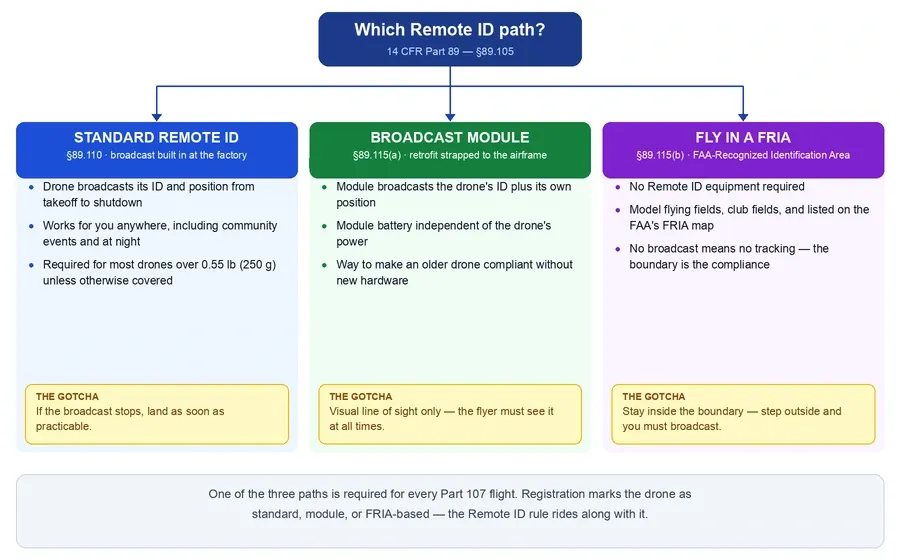 Three doors to the same requirement: broadcast, module, or FRIA — each with the condition that gets forgotten.
The Message Elements (§89.305)
What a standard-RID aircraft must broadcast — worth reading once so decode questions feel familiar:
- Identity: the aircraft’s serial number, or a session ID
- Latitude/longitude of the control station
- Geometric altitude of the control station
- Latitude/longitude of the unmanned aircraft
- Geometric altitude of the unmanned aircraft
- Velocity of the unmanned aircraft
- A UTC time mark
- Emergency status indication
Performance floor (§89.310): position accurate within 100 feet (95% probability), broadcast at least once per second, no more than 1 second from measurement to broadcast.
Two More Part 89 Rules the Exam Likes
- Aeronautical research (§89.120): the FAA may authorize RID-less operations conducted solely for aeronautical research or to show compliance with regulations
- ADS-B Out prohibition (§89.125): ADS-B Out equipment cannot be used to meet Remote ID — that spectrum belongs to manned aviation’s collision-avoidance system, and drones squatting on it are expressly banned
Applying for Your Remote Pilot Certificate
Eligibility (§107.61): at least 16 years old, able to read, speak, write, and understand English (with a medical exception process), no known condition that would interfere with safe operation, and a passed knowledge test.
After passing the exam:
- Log into IACRA at iacra.faa.gov
- Start a new application — select “Remote Pilot” as the certificate type
- Enter your knowledge test results (IACRA verifies them — the 17-digit test ID on your AKTS)
- Complete and sign the application
Temporary Certificate
A temporary remote pilot certificate is issued for up to 120 calendar days (§107.64), giving full operating privileges while the permanent card is processed.
Permanent Certificate
The permanent certificate has no expiration date — but the privileges expire on a clock, next section.
Staying Current
14 CFR §107.65, the whole rule in one sentence: you may not act as remote PIC unless, within the previous 24 calendar months, you have:
- Passed the initial knowledge test, or
- Completed recurrent training (the free online course at faasafety.gov — most pilots’ choice), or
- As a Part 61 pilot (non-student), completed the recurrent training for Part 61 certificate holders
“24 calendar months” is calendar math, not anniversary math — pass on March 10, 2026, and your currency runs through March 31, 2028. The exam tests both the number and the calendar-month wording.
What If You Already Have a Pilot’s License?
Holders of a Part 61 pilot certificate (other than student) skip the testing center (§107.61(d)(2)): complete the Part 107 online training course for Part 61 pilots, hold a current flight review under §61.56, and file through IACRA — the application goes via a Flight Standards office, DPE, CFI, or other authorized person who verifies identity (§107.63(b)).

Key Facts to Walk In With
ACS references: I.B.K1, I.F.K1–K7, I.C.K3
- Registration: $5/aircraft, 3 years, exterior marking (§§48.100, 48.205); update within 14 days of changes (§48.115)
- Under-250g exemption: recreational-only (§48.15(b))
- Remote ID since Sept 16, 2023: standard / module / FRIA (§§89.105–89.115)
- Module ops: VLOS at all times, no VO; broadcasts take-off location, not control-station position
- FRIA: CBO/education sponsors, 48-month grants, aircraft and pilot stay inside
- §89.120 aeronautical research; §89.125 ADS-B prohibited for RID
- Certificate: 16+ years old; temp cert 120 days (§107.64); currency 24 calendar months (§107.65)
Quick Check
Q: How much does drone registration cost and how long is it valid? A: $5.00 per aircraft, valid 3 years.
Q: Where must the registration number be placed? A: On an external surface of the aircraft, legible, affixed to stay for the whole operation (§48.205).
Q: You’re hired to photograph a wedding with a 249-gram drone. Register it? A: Yes. The 0.55-lb exception applies only to exclusively recreational operations (§48.15(b)).
Q: How long is your Part 107 currency valid before recurrent training? A: 24 calendar months from the qualifying test or training (§107.65).
Q: What’s the Remote ID difference between a standard aircraft and a broadcast module? A: Standard broadcasts the control-station location and its own serial/session ID; a module broadcasts the module serial and the take-off location — and module flights require VLOS with no visual-observer option.
Q: Can you use your drone’s ADS-B Out transponder to satisfy Remote ID? A: No — §89.125 prohibits using ADS-B Out to comply with Remote ID.
What’s Next?
Paperwork done. Now let’s learn the rules you’ll be tested on, starting with the operating regulations in 14 CFR Part 107.
This free course covers the essential knowledge, but if you want video walkthroughs, practice exams, and instructor support, Pilot Institute’s Part 107 course is the most comprehensive option available.