Emergency Procedures
Emergencies are heavily tested because the FAA wants proof you won’t panic when your drone misbehaves. The hierarchy is fixed: people first, property second, aircraft last — and the regulatory frame already flexes for you: §107.21 lets the PIC deviate from any rule to the extent an in-flight emergency requires, with a written report owed only if the FAA asks. What follows is the playbook for the ways small UAS actually fail.
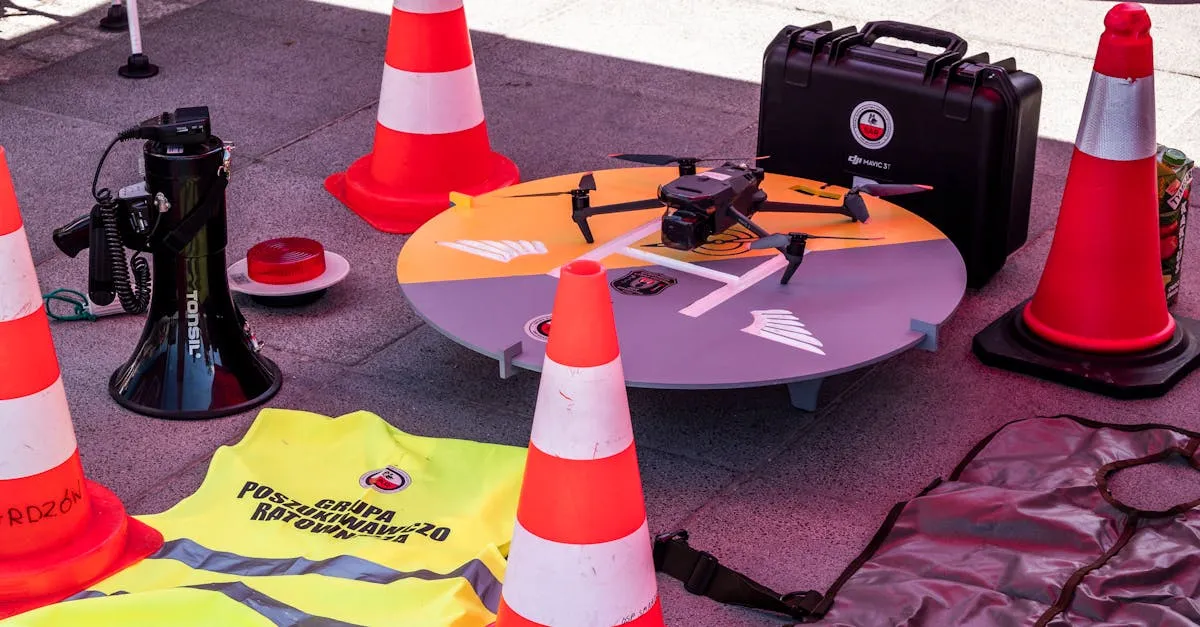
Flyaways
A flyaway occurs when the aircraft stops responding to control inputs and moves unpredictably — distinct from loss of link, where the aircraft is executing its programmed failsafe.
What to Do
- Immediately alert anyone under the flight path: shout, wave, get eyes up
- Note the last known direction and altitude — this is the search datum and the ATC briefing
- If in controlled airspace, notify ATC — the tower or approach frequency, by phone if you don’t carry a radio. A flyaway in controlled airspace is the textbook ATC-notification scenario
- Attempt to regain control: switch flight modes, reposition for signal, command failsafe/RTH
- Report: injury or property damage over the §107.9 thresholds triggers the 10-day FAA report
Flyaway in controlled airspace = notify ATC immediately. The drone can enter manned aircraft flight paths without asking anyone — the notification is the mitigation.
Loss of Link
The control link dies. This is not a flyaway: modern aircraft run programmed failsafes —
- Return to Home (RTH): climbs and flies to the recorded home point
- Hover then land: position-hold with GPS, descend if link doesn’t return
- Land in place: the conservative default when the programming distrusts its own navigation
The PIC’s job is less about the aircraft and more about the RTH path: a climb-to-altitude return over a crowd, wires, or the airport next door is the failure you should have configured away before launch (set home point thoughtfully; check RTH altitude against obstacles).
Loss of link = drone follows pre-programmed procedures. Flyaway = drone follows nothing you programmed. The exam swaps these definitions constantly.
Loss of GPS
Without satellites:
- RTH may fail (no home-point navigation)
- Position hold drifts — the aircraft becomes a balloon with attitude control
- Many aircraft degrade to ATTI (attitude) mode: level and controllable, but the wind carries it
The recovery: reduce altitude, face the aircraft into a hover, and hand-fly it back with visual references — no GPS required. This is the one aircraft-handling skill worth practicing on purpose (see the maintenance and inspection lessons for why simulator time counts).
If GPS drops mid-flight, resist the urge to climb or to trust RTH. Descend out of the wind layer, keep the aircraft within a walk’s distance, and land at the first safe patch of ground.
Lithium Battery Emergencies
Lithium-polymer cells carry a chemistry that fails hot: thermal runaway — an internal short cascading cell to cell, self-oxidizing, burning at temperatures that ignite neighboring materials and re-igniting after apparent extinguishment. The FAA’s safety alerts to operators (SAFOs) on lithium battery air transport treat them as a standing hazard; your aircraft carries the same energy in a lighter wrapper.
In flight, suspected battery trouble (swelling readings, sudden voltage sag, temperature warnings):
- Fly away from people and property immediately — the ground track matters more than the landing quality
- Land at the first clear area — grass beats pavement, distance beats precision
- Do not hand-catch. Ever. A landing you can walk to beats a hand you can’t
- Evacuate and isolate: a post-crash pack can ignite minutes later
- Fight it with the right tools: sand/dirt smothering, or a Class D or lithium-specific (e.g., AVD) extinguisher — not water, which feeds the reaction
On the ground, the prevention list is shorter than the cure: no charging unattended, no charging damaged/puffed cells, storage charge for the off-season, transport in fireproof pouches, and retirement at the manufacturer’s cycle-count or swelling threshold — whichever comes first.
A battery event at night adds visibility chaos: the fire is the brightest thing for a mile, your night-adapted eyes are ruined for everyone watching, and the safe landing patch you walked at dusk is now invisible. Pre-stage a flashlight at the control station — not on your phone.
Emergencies Over People (V.C.K6)
An aircraft problem while operating under Category 1–4 rules changes one priority: the people below are non-participants by definition, and the category’s injury assumptions just failed. The sequence: arrest drift away from the populated area first, then solve the aircraft’s problem. A hard landing in an empty parking lot is a Category-compliant outcome; a soft landing in a crowd is not. If the aircraft is descending uncontrollably over people and any impact-mitigation exists — fly it into the tree, the bush, the wall — spend the aircraft.
The Emergency Kit
What separates an incident from an ordeal is usually ground kit, not aircraft skill. The working baseline:
- Fire response: sand/soil source identified at every site (or a bucket), plus a lithium-rated extinguisher in the vehicle — Class D or AVD type
- Flashlight, staged at the control station, for night battery events and searching crop rows for a downed aircraft
- First-aid basics — a drone striking a bystander is a trauma event before it is an FAA event
- Spare battery and SD card: half of “emergencies” are operational (lost footage, dead controller) with aircraft intact
- Phone numbers: tower/approach facility phone numbers for your frequent operating areas (for the flyaway call), plus the FAA regional operations center
- Written lost-aircraft procedure: last-known coordinates, direction of flight, RTH behavior — the notes you’ll want when your hands are shaking
Run the kit check with the preflight checklist; it’s the same habit wearing different gloves.
Precautionary Landings
Sometimes the safest action is landing before anything technically fails:
- Deteriorating weather — visibility sagging toward 3 SM, gusts building
- Unexpected crewed aircraft in the area
- Battery trending below plan
- Erratic behavior, sensor warnings, one healthy motor screaming
- Something feels wrong — the unquantified instinct is a trained input; use it
The FAA encourages precautionary landings — landing early is the anti-”get-home-itis,” one of the classic hazardous attitudes you’ll meet again in the ADM lesson.
After the Event: Reports and NTSB
Two reporting tracks, and one that most pilots forget:
- FAA report (§107.9): within 10 calendar days, for serious injury/loss of consciousness or property damage over $500 (repair cost or total-loss fair market value, excluding the drone)
- NTSB (49 CFR part 830): an aircraft accident — defined as an occurrence with death, serious injury, or substantial damage — requires immediate notification to the NTSB, plus a later written report. Most drone incidents don’t meet it, but a hospitalizing injury or an aircraft destroyed by fire formally does
- ASRS: for the inadvertent rule deviation that happened while you were saving the day — NASA’s confidential report within 10 days documents good faith
Know the boundary: FAA’s §107.9 is the common 10-day drone report; NTSB part 830 is the rare, serious one with immediate notification. The exam’s distractor is applying NTSB timing to a $600 fence.
Key Facts to Walk In With
ACS references: V.C.K1–K7
- §107.21: deviate as necessary in-flight; written report on request
- Flyaway vs loss of link vs GPS loss — distinct failures, distinct playbooks
- Flyaway in controlled airspace: notify ATC immediately
- Lithium: thermal runaway, no water, no hand-catching, isolation after landing
- OOP emergencies: move the failure away from people first, spend the aircraft if needed
- Night: pre-stage light; battery events blind everyone
- §107.9 (10-day FAA) vs part 830 (immediate NTSB for serious accidents) vs ASRS (violation good-faith)
Quick Check
Q: What is the difference between a flyaway and a loss of link? A: Loss of link executes pre-programmed failsafe (RTH/hover/land); a flyaway follows no programmed procedure.
Q: What should you do if your drone has a flyaway in controlled airspace? A: Notify ATC immediately — tower or approach, phone if no radio.
Q: Should you use water on a lithium battery fire? A: No — smother with sand/dirt or use a Class D / lithium-specific extinguisher; the reaction self-oxidizes.
Q: Your drone’s motor fails over a Cat 2 operation, and it will land somewhere in the next 10 seconds. Where? A: Not on people — arrest drift toward the nearest unoccupied impact (trees, walls, open ground) and spend the aircraft.
Q: A bystander is hospitalized after a drone strike. Beyond the FAA 10-day report, what else? A: Immediate NTSB notification — a serious-injury event is an aircraft accident under 49 CFR part 830.
What’s Next?
Now let’s cover the most important safety topic: Aeronautical Decision Making. How to think like a safe pilot.
This free course covers the essential knowledge, but if you want video walkthroughs, practice exams, and instructor support, Pilot Institute’s Part 107 course is the most comprehensive option available.