Water, Reflections & Abstract Aerials
Why It Matters
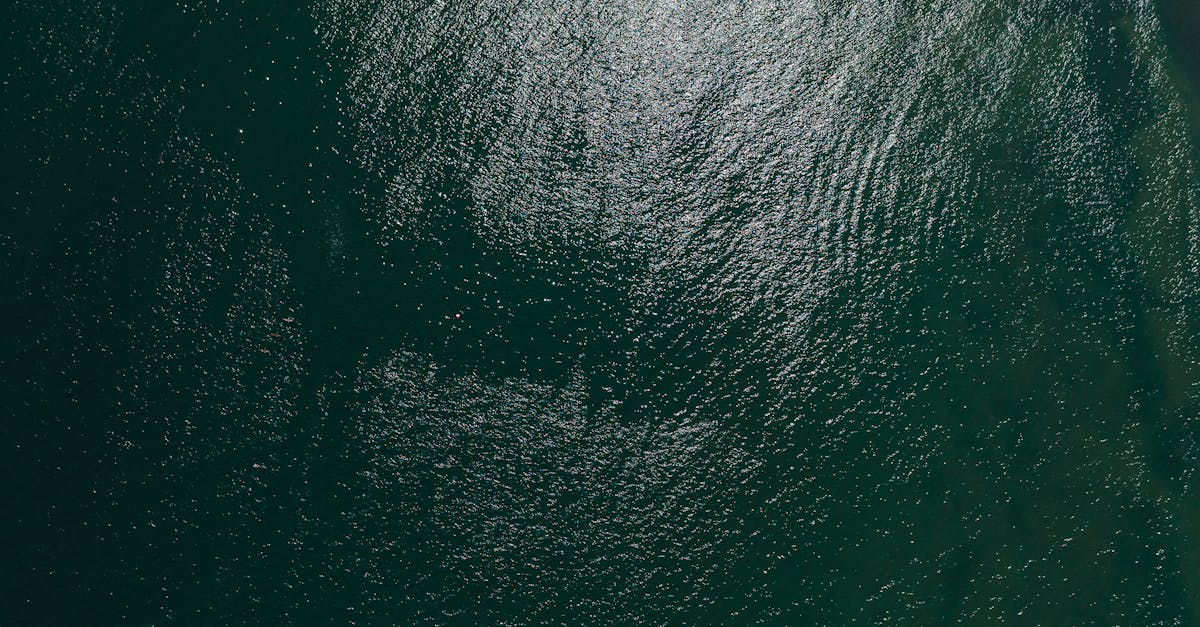
Water is one of the most compelling subjects for aerial photography, and it’s completely different from above than from ground level. Calm water becomes a perfect mirror. Turbulent water becomes abstract art. The intersection of water and land creates color gradients invisible from the ground. And at the right altitude, ordinary harbors, rivers, and coastlines transform into geometric compositions.
This is the lesson that changes how you see the world from above.
Water as a Mirror
Calm, flat water at dawn reflects the landscape like a perfect mirror. This is one of the most powerful aerial photography effects, and it only works when conditions are right.
Conditions for Mirror Reflections
- Early morning: before wind picks up, when water is glassiest
- Lakes and ponds: sheltered water with minimal current
- No wind: even a light breeze destroys the mirror effect
- Low altitude: too high and the reflection loses detail; 50-150 feet is ideal
Technique
- Position the drone so the reflection fills a significant portion of the frame
- Shoot straight down (gimbal at -90 degrees) for perfect symmetry
- Or shoot at a slight angle to include both the reflected subject and the real subject
- Use manual exposure. The reflection and the real scene may need different treatment in post.
Straight-down shots over calm water create perfect top-bottom symmetry: the real landscape on one half, its mirror image on the other. This symmetry is inherently satisfying to the human eye. It’s one of the most shareable types of drone photos.
Color Gradients at Water’s Edge
Where water meets land, color changes dramatically. From above, you’ll see:
- Deep blue ocean transitioning to turquoise shallows to white sand to green vegetation
- Brown river water meeting blue lake water at a distinct dividing line
- Green agricultural runoff creating vivid color boundaries in bays and estuaries
These color transitions are invisible from ground level. From 200-400 feet, they become the photograph.
Capturing Color Gradients
- Shoot at an oblique angle (gimbal at -30 to -60 degrees) to capture the transition zone
- Saturated colors respond well to slight Vibrance boost in editing
- Use a polarizing filter to cut surface glare and reveal underwater colors
Wave Patterns and Ocean Textures
Moving water creates patterns that change every second. From above, waves become:
- Geometric line patterns: parallel lines of swell viewed from the side
- Foam textures: white breaking waves against dark water
- Turbulence patterns: where currents meet, water creates visible swirls and lines
Technique
- Shoot at 1/500s or faster to freeze wave motion
- Or use a slow shutter (1/10s with ND filter) to blur waves into silky texture
- Altitude matters. At 50 feet you see individual waves; at 300 feet you see the pattern.
Abstract Aerial Photography
The most artistic drone photos happen when you stop trying to photograph “a thing” and start photographing patterns, textures, and colors. Abstract aerials transform ordinary landscapes into art.
Subjects That Become Abstract from Above
| Ground View | Aerial View |
|---|
| Agricultural fields | Geometric color blocks | | Meandering river | Flowing organic line | | Harbor with boats | Geometric composition of shapes | | Sand dunes | Light and shadow patterns | | Forest canopy | Textured color field | | Parking lot | Grid pattern with colored rectangles | | Ice on a lake | Cracked texture with blue tones |
Finding Abstracts
- Fly higher: 200-400 feet starts to abstract subjects
- Look straight down: -90 degree gimbal removes horizon and scale references
- Search for patterns: repetition, line, color blocks, texture changes
- Remove context: the best abstracts don’t immediately reveal what the subject is
The best abstract aerial photos make viewers ask “what is that?” If someone looks at your photo of an agricultural field and immediately sees “a field,” you’re too low or the composition isn’t tight enough. Crop in, fly higher, or change the angle until the subject becomes ambiguous.
The Low-Level Water Shot
Think of your drone not as an aerial camera but as “a tripod you can put anywhere.” Some of the most compelling water shots are taken at eye level, 2-5 feet above the surface:
- Position the drone just above the water
- Fly slowly forward along the surface
- The camera captures foreground water detail with the landscape beyond
- This creates a sense of immersion impossible at higher altitudes
Flying low over water is risky. One glitch and your drone is submerged. Never fly low over water without visual line of sight, and always be ready to gain altitude immediately. Water landings are almost always total losses.
Quick Check
Q: What conditions create the best mirror reflections? A: Early morning, zero wind, sheltered water (lakes/ponds), and low altitude (50-150 feet).
Q: What makes an aerial photo “abstract”? A: When the subject is no longer immediately recognizable. Patterns, textures, and colors take priority over the literal subject. Higher altitude and straight-down angles help.
Q: What’s a polarizing filter’s effect on aerial water photos? A: It cuts surface glare and reflections, revealing underwater colors and enriching the visible color gradients.
What’s Next?
Water and abstracts are a rich creative vein. Now let’s master the most popular time of day for drone photography: sunset.
Pilot Institute: see the world differently.