Composition from Above
Aerial Composition Is Different
Ground photography rules still apply, but they shift when you’re 200 feet up. The camera points down more than forward. The horizon often disappears. Patterns and geometry become your primary compositional tools.
The Core Principles
Rule of Thirds
Place your subject at one of the four intersection points of a 3x3 grid, not dead center. Most drone apps show a grid overlay. Use it.
Rule of thirds works best when the scene is not symmetrical (a coastline with the ocean on one side, a road winding through a valley).
Dead Center (When Symmetry Works)
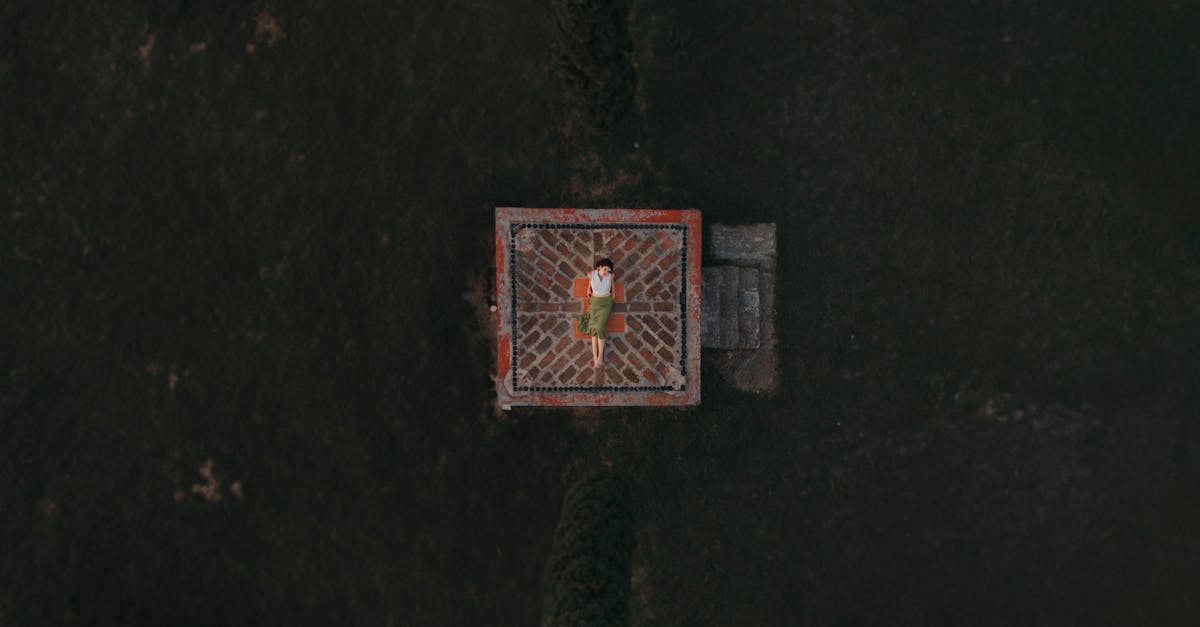
When the scene is symmetrical (a circular fountain, a bridge from directly above, a perfectly straight road), center composition creates strong, graphic images. Breaking the rule of thirds is the right move when symmetry is the story.
Leading Lines
Roads, rivers, trails, fences, bridges. Any line that draws the viewer’s eye from the foreground into the image. Leading lines create depth and narrative movement.
Pro move: Fly low and angle the camera so the leading line starts at the bottom of the frame and draws the eye toward the horizon or focal point.
Patterns and Repetition
From above, the world is full of patterns invisible from the ground:
- Agricultural fields in geometric rows
- Ocean waves creating repeating curves
- Parking lots with aligned vehicles
- Sand ripples, rock formations, tree canopies
Patterns are what make aerial photos look distinctly aerial. Ground photographers can’t see them. When you spot a pattern from above, photograph it. These are the images that grab attention on a feed.
Texture and Contrast
Aerial photos benefit from visible texture (sand dunes, water ripples, crop rows, mountain ridges). Side-lighting (sun from the side) reveals texture through shadows. Noon lighting hides texture by eliminating shadows.
Scale References
Include something the viewer recognizes (a person, a car, a building) to establish the scale of the landscape. Without a reference, viewers can’t tell if they’re looking at a 10-foot stream or a mile-wide river.
Common Composition Mistakes
The “Straight Down Satellite Shot”
Pointing the camera straight down at random terrain produces images that look like Google Maps screenshots. Top-down photos work when there’s a clear pattern, subject, or geometric interest.
No Subject
Wide landscapes need a focal point. A lone tree, a boat, a building, a road. Something for the eye to land on. Pure landscape with no subject feels empty.

Too High
The higher you fly, the flatter the image becomes. Shadows disappear, details blur, and everything looks like a map. Most compelling aerial photos are taken below 200 feet.
Quick Check
Q: When should you break the rule of thirds? A: When the scene has symmetry. Center composition creates strong, graphic images.
Q: What makes patterns so powerful in aerial photography? A: They’re invisible from the ground. Capturing them produces distinctly aerial images that grab attention on a feed.
Q: Why do photos taken too high look flat? A: Shadows disappear, details blur, and everything looks like a satellite map rather than a photograph.
What’s Next?
Composition theory in hand. Let’s apply it to specific photo types.
Pilot Institute: compose like a professional.