Left Downwind for Runway 16: Decoding Airport Radio Calls
Airport radio chatter sounds like a foreign language. Here's the complete decoder ring for runway numbers, traffic patterns, and common radio calls.
“Cessna 172, left downwind for Runway 16, cleared to land.” If you’ve ever listened to airport radio chatter and had no idea what they were saying, you’re not alone. Here’s the complete decoder ring.
How Runways Are Numbered
Runway numbers correspond directly to their magnetic heading, divided by ten and rounded to the nearest whole number.
Runway 16 = 160° magnetic heading. Runway 9 = 090° (due east). Runway 27 = 270° (due west).
Every runway has two ends, each with its own number. These numbers always differ by 18 (representing 180° — the opposite direction). Runway 16’s opposite end is Runway 34 (340°).
Runway numbers are always one or two digits. You’ll never see three-digit runway numbers because magnetic headings only go from 001 to 360.
Over time, Earth’s magnetic north drifts. When this drift becomes significant, airports repaint runway numbers to match updated headings. Rare, but it happens.
Traffic Pattern Legs Explained
Manned aircraft fly a standard rectangular pattern around the runway called the traffic pattern. Understanding this flow tells you where aircraft are at any moment.
- Upwind — Parallel to runway, same direction as landing, on the departure side. Climbing out.
- Crosswind — Perpendicular to runway, flying away from airport. Positions for next turn.
- Downwind — Parallel to runway, flying OPPOSITE to landing direction. Pilots configure for landing here. Typically a half-mile to a mile from the runway.
- Base — Perpendicular to runway, heading toward final approach. Descent typically begins here.
- Final — Aligned with runway centerline, heading toward landing.
What “Left Downwind” Means
“Downwind” = parallel to runway, opposite direction of landing traffic. If someone lands on Runway 16 (heading 160°), downwind traffic heads roughly 340°.
“Left” = the downwind leg is to the LEFT of the runway, from the pilot’s perspective looking down the runway in the landing direction.
So “left downwind for Runway 16” = aircraft flying parallel to Runway 16, on the left side, heading roughly 340°, preparing to turn base and final for landing.
Standard traffic pattern is LEFT — the default at virtually all airports unless published otherwise. Right patterns exist for noise abatement, terrain, or conflicting airspace.
Why Drone Pilots Need to Know This
As a Part 107 pilot operating near airports, you’ll rarely be required to talk to anyone — LAANC authorization is handled entirely in the app, with no radio call. But listening on a radio (or an app feed) is one of the best situational-awareness tools you can have, and certain special operations do put you in direct contact with ATC.
Understanding radio communications builds situational awareness. “Traffic on downwind” tells you exactly where to look. “Left base for Runway 22” lets you picture the aircraft’s position relative to your operation.
This knowledge could save lives. Knowing where manned aircraft are in the traffic pattern helps you avoid conflicts. And speaking aviation’s language builds credibility with ATC.
Common Radio Phrases Decoded
| Phrase | Meaning |
|---|---|
| ”Cleared for the option” | Touch-and-go, full stop, or go around — pilot chooses |
| ”Number two for landing” | Second in sequence, keep visual separation |
| ”Hold short” | Stop before entering runway (mandatory) |
| “Line up and wait” | Taxi onto runway centerline, hold position, wait for takeoff clearance |
| ”Go around” | Abort landing, climb, fly pattern again |
| ”Traffic on downwind” | Another aircraft on the downwind leg — traffic advisory |
| ”Two-mile final” | Aircraft two miles from runway threshold on final approach |
| ”Wake turbulence” | Previous aircraft was heavy — delay to avoid wake vortices |
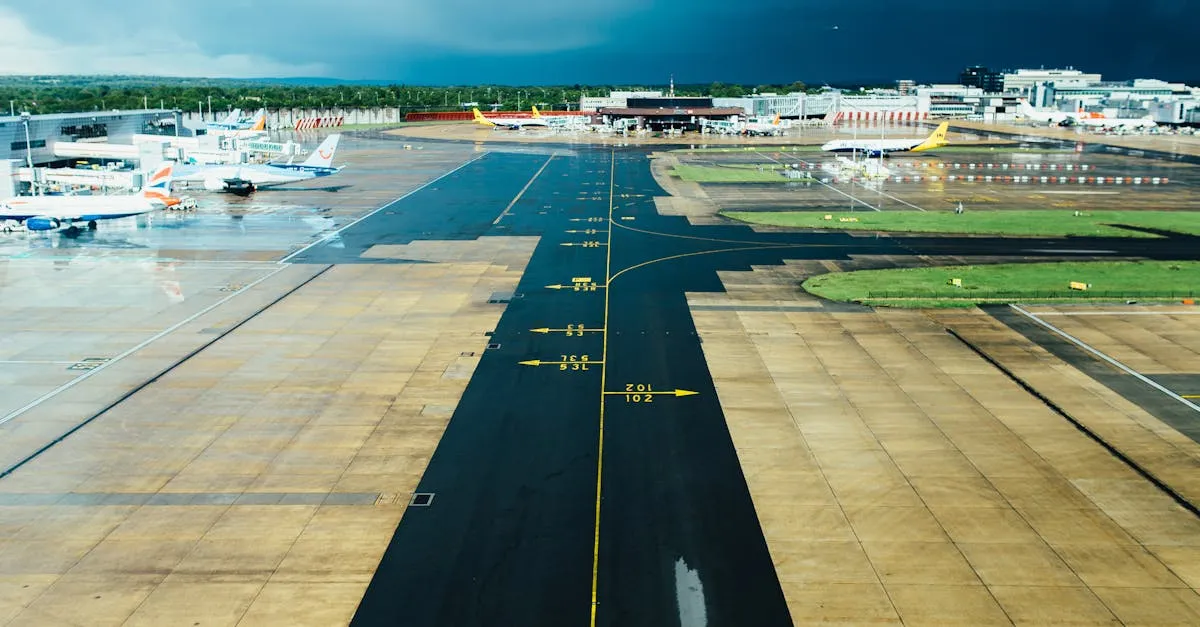
Runway Orientation Quick Reference
- Runway 9/27 = east-west (90° and 270°)
- Runway 18/36 = north-south (180° and 360°)
- Runway 13/31 = southeast-northwest (130° and 310°)
Wind direction determines active runway. Aircraft always land INTO the wind. Wind from the south → Runway 18. Wind from the north → Runway 36.
Frequently Asked Questions
How do runway numbers work? Runway numbers correspond to the magnetic heading divided by ten. Runway 16 points to 160 degrees, while its opposite end is Runway 34 (340 degrees). Numbers always differ by 18 between ends.
What does “left downwind for Runway 16” mean? An aircraft flying parallel to Runway 16 on its left side, heading roughly 340 degrees, opposite the landing direction. The pilot is preparing to turn base and final.
Why do drone pilots need to understand traffic patterns? LAANC authorization itself requires no radio — it’s processed in the app — but listening to airport traffic gives you real-time awareness of where crewed aircraft are. Understanding calls like “traffic on downwind” helps you visualize aircraft positions and avoid conflicts.
What does “cleared for the option” mean? The pilot can choose between a touch-and-go, full stop landing, or go-around. The controller authorizes any of these without additional clearance.
How is the active runway determined? Wind direction dictates it because aircraft always land into the wind. South wind means Runway 18 is used; north wind means Runway 36.
Why would an airport use a right traffic pattern? Noise abatement over populated areas, terrain avoidance, or conflicting airspace. Left remains the standard default unless specifically published otherwise.
Ready to master airport operations? Our free Part 107 Course covers everything for the exam. Deep dive with Airport Operations and Radio Communications.